
Do Stop Leak Products Actually Work? An Honest Answer.
If you’ve spent any time in a forum thread or a comment section, you’ve seen it: someone calls stop leak “snake oil in a bottle” and a dozen people pile on. We’ve made stop leak products for over 75 years, so you’d expect us to argue. We’re not going to – at least not the way you’d think.
The honest answer is this: chemical stop leak products absolutely work, on the leaks they’re designed to fix, used the right way. They do not work on everything, and anyone who tells you otherwise is selling something. The reason the “snake oil” reputation sticks is that people reach for the wrong product, or use it on a problem no bottle was ever going to solve, and then blame the bottle.
Let’s clear it up.
How does stop leak actually work?
Here’s the part the critics usually skip: “stop leak” isn’t just “one thing”. Let’s take a rough example.
Say there are three different mechanisms doing three different jobs in a typical stop leak. Not unusual for a modern leak repair formula.
Lumping them together is where the confusion starts.
Seal conditioners. Most engine, transmission, and power steering leaks aren’t holes in metal – they’re seals and gaskets that have dried out, shrunk, and gone hard with age and heat. A seal conditioner restores the plasticizers that rubber loses over time, so the seal swells back to size, softens, and seats properly again. The leak stops because the part that was supposed to be sealing it is doing its job again. This is why these products work so well on high-mileage engines: that’s exactly the kind of leak high-mileage engines develop.
Particle and fiber sealers. For cooling systems, the job is different. These products carry sealing particles suspended in the coolant. They flow harmlessly through the system until they reach a small crack or hole, where the change in temperature and pressure makes them lodge, bridge the gap, and cure into a seal. The good ones are engineered to seal small breaches only – and to stay suspended everywhere else.
The difference between the “good ones” and the others is a pretty wide gap.
Head gasket sealers. A blown head gasket is a sealing problem under combustion heat and pressure. The right chemistry, carried to the internal leak location, reacts to that heat and hardens into a seal that can hold against combustion gases. That’s a real repair on a real failure – within limits we’ll get to.
Three mechanisms, three problems. Use the right one and it works. Grab the cooling-system bottle for an oil leak and you’ll prove the skeptics right.
Above all – brand matters. What you see is a bottle on a shelf. What’s behind it is the brand’s R&D and formulation quality. Like many things, chemical repair solutions are not created equal. Far from it, in fact.
When stop leak products genuinely work
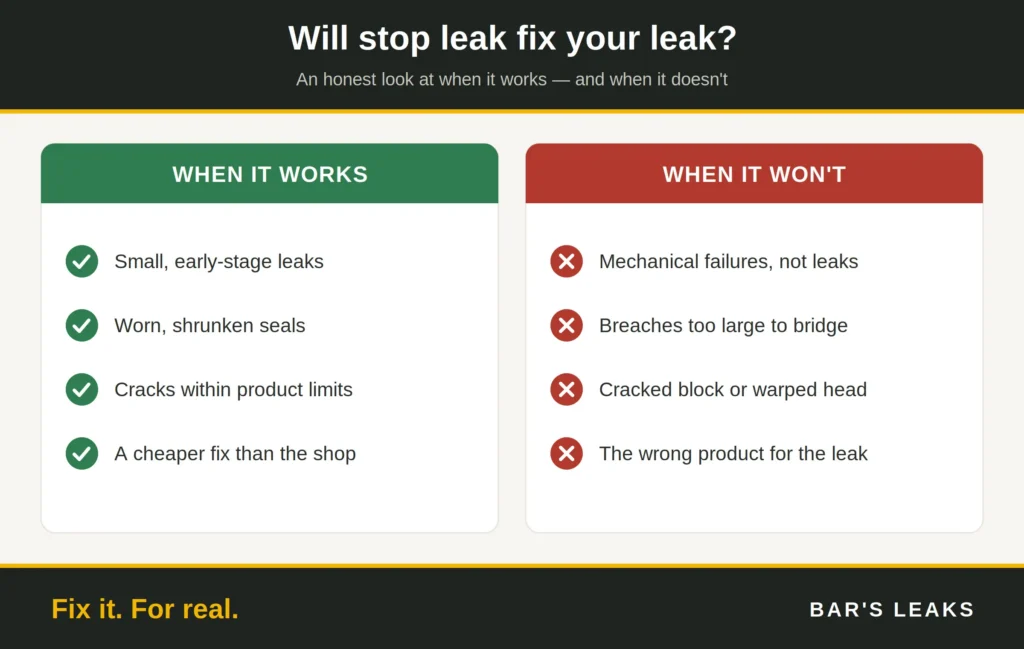
Stop leak products earn their keep when:
The leak is small and you caught it early. Weeping seals, seepage, a slow drip, a minor coolant loss. The earlier you treat it, the higher the success rate – every time.
It’s a seal-shrinkage leak on a high-mileage engine. Rear main seals, valve cover gaskets, transmission and power steering seals that have hardened with age. This is the “home field advantage” for a seal conditioner.
The breach (leak) size is within the product’s tolerance. Quality cooling and head gasket products tell you the size of crack or hole they can seal. Inside that window, they work. That’s not marketing – it’s chemistry with a spec.
You need an affordable, reliable fix instead of a four-figure shop bill. A seal or gasket repair at a shop can run well over a thousand dollars in labor alone. A bottle that fixes the leak for the price of lunch isn’t a compromise – for a lot of drivers, it’s the smart call.
The vehicle isn’t worth the price of a repair. For many, a car with a serious leak is also a financial mess: would you pay $2000 for a head gasket repair on a car worth $4000? That’s 50% of the car’s value in a single repair. In cases like this, a quality stop leak can mean the difference between having a car and being sidelined entirely.
When stop leak products won’t work – and we’ll tell you straight
This is the part that builds trust, so here it is plainly. Stop leak is the wrong tool when:
The failure is mechanical, not a leak. A spun bearing, a thrown rod – no additive fixes those, and we’d never claim it does.
The leak is too big. If you’re adding coolant nearly as fast as you’re losing it, or a gasket has failed catastrophically, the damage is past what any pour-in product can bridge. That’s a teardown. Many people fail to accurately diagnose how severe their leak is at the outset.
A hard part is cracked or warped beyond tolerance. A badly cracked block or a severely warped head needs to be repaired or replaced. A sealer buys time at best.
You used the wrong product for the leak. A cooling-system sealer will not fix an oil leak. Match the product to the problem or you’ve wasted the bottle.
If your problem is on this list, the right move isn’t another bottle – it’s a mechanic. We’d rather tell you that than sell you a fix that won’t hold.
“But won’t it clog my engine?”
This is the objection behind most of the horror stories, so let’s deal with it head-on. A properly formulated stop leak is designed to seal where there’s a leak – where the temperature, pressure, or air-exposure conditions at the breach trigger it – and to stay suspended and inert everywhere else. Done right, it doesn’t gum up passages or coat parts that aren’t leaking.
The horror stories almost always trace back to one of three things: a cheap product with crude chemistry (the case with many “store brands”), an oversized dose, or using a sealer to chase a failure it was never going to fix and leaving it in to “try harder.” A quality formulation and following the directions are not optional details – they’re the difference between a fix and a forum post. It’s a fair reason to be choosy about which bottle you grab.
How to give stop leak its best shot
Match the product to the leak. Engine, cooling, transmission, power steering – use the one built for the system that’s leaking. You’d be surprised to learn this mixup happens more than you’d think.
Catch it early. Treat the small leak now, not the big one later. Early action is critical.
Follow the dosage. More is not better. The dose is engineered for your system’s capacity.
Give it time to work. Most seal conditioners need a couple hundred miles of driving to fully seat the seals. Don’t judge it after one trip around the block.
Be honest about the diagnosis. If the symptoms point to mechanical failure, no bottle changes that.
The bottom line
Stop leak products work. Not on everything, not by magic, and not as a substitute for a mechanic when something is genuinely broken. But for the small, age-related, seal-and-gasket leaks that the vast majority of drivers actually deal with, the right product used correctly is a proven, affordable, real repair.
We’ve been making chemical repair products for 75+ years, we’re ISO 9001 certified, and our products are made in the USA – because for three generations of drivers, the fix has been real. That’s the whole point. We thoroughly test our products in-house and with outside laboratories to ensure our products are safe and effective for all vehicles.
Fix it. For real.
Frequently Asked Questions
Do stop leak products really work, or are they snake oil?
They work on the leaks they’re designed for – small, early-stage, seal-and-gasket leaks – when you match the right product to the right system and use it correctly. They don’t fix mechanical failures or breaches too large to bridge, which is where the “snake oil” reputation comes from.
Will stop leak clog or damage my engine?
A properly formulated product is designed to seal only where a leak exists and stay inert elsewhere, so it doesn’t clog healthy passages. Problems usually come from low-quality products, overdosing, or using a sealer on a failure it can’t fix.
How long does stop leak take to work?
Cooling and head gasket sealers can seal a small breach quickly once they reach it. Seal conditioners typically need up to a couple hundred miles of driving to fully recondition and re-seat the seals.
When should I see a mechanic instead?
When the problem is mechanical (slipping transmission, bearing or engine noise), when you’re losing fluid almost as fast as you add it, or when a hard part like the block or head is cracked or warped beyond a sealable tolerance.